
DigiKai OS Blog
How to Build an Agency That Doesn’t Depend on Referrals
Build a predictable agency growth system that generates qualified opportunities without depending on referrals to bring you your next client.
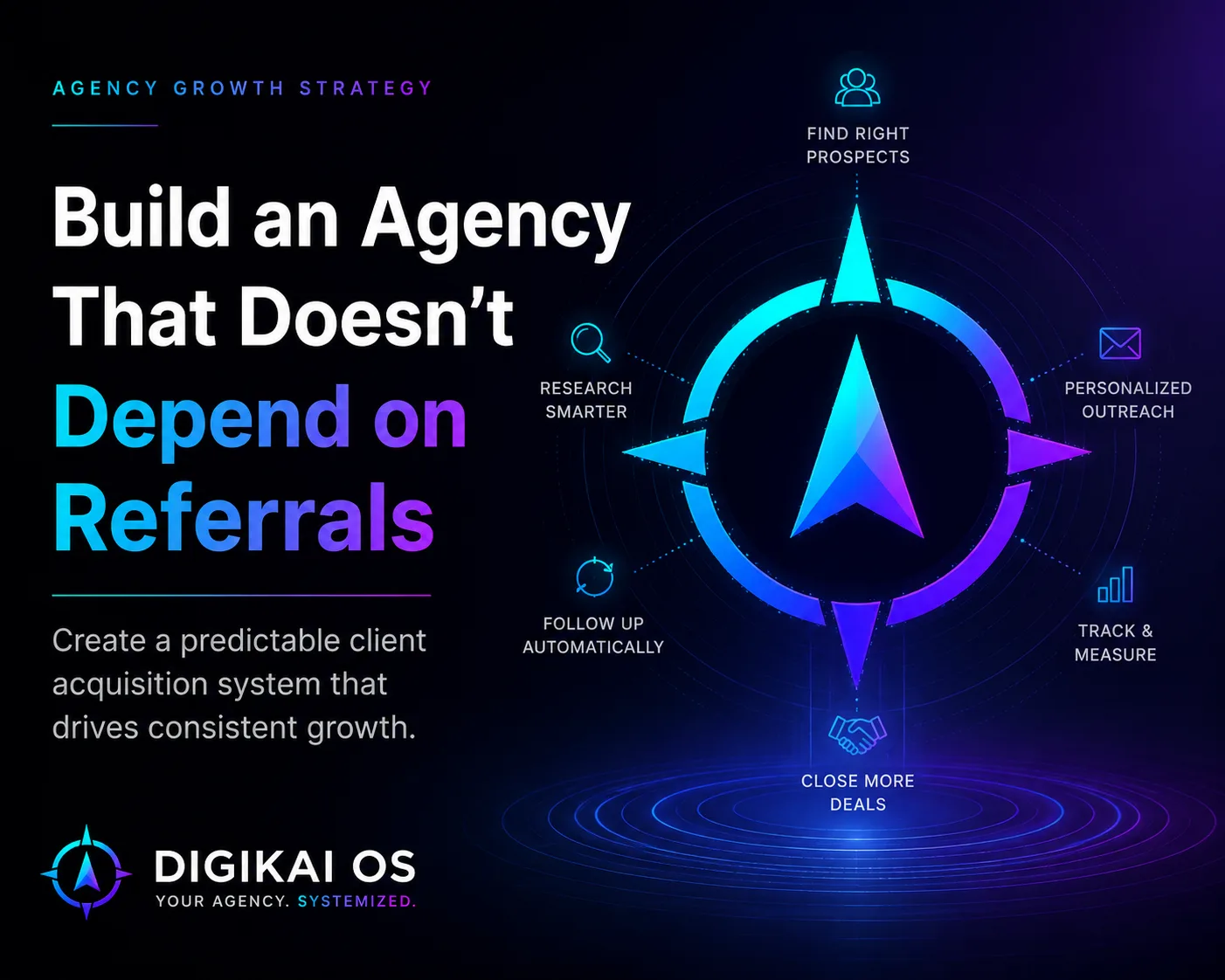
How to Build an Agency That Doesn’t Depend on Referrals
For a lot of marketing agencies, referrals aren't just one source of new business.
They're the entire growth strategy.
A client tells another business owner about you. A former colleague sends someone your way. Someone sees your work and makes an introduction.
Then nothing happens for three weeks.
The problem isn't that referrals are bad. Referrals can be some of the highest-quality leads an agency receives.
The problem is depending on them.
You can't predict when someone will refer a business to you. You can't control how many referrals you'll receive next month. And you can't build reliable revenue projections around people hopefully remembering your name.
If you want to build a predictable agency, you need something referrals can't give you:
A repeatable client acquisition system.
Referrals Feel Easier Because They're Warm
There's a reason agency owners love referrals.
The prospect usually arrives with some level of trust already established.
Instead of explaining why your agency is credible, someone else has already done part of that work for you.
That often means shorter sales cycles and fewer objections.
But there's a hidden tradeoff.
You didn't control when that opportunity appeared.
And when referrals slow down, many agencies suddenly realize they don't actually have a lead generation system.
They have a reputation.
Those aren't the same thing.
A strong agency should have both.
Predictable Growth Starts With Knowing Who You Want
One of the biggest mistakes agencies make is trying to generate "more leads."
That's too broad.
The goal isn't more businesses in your database.
It's more businesses that could realistically become good clients.
Before building an outbound system, define what a qualified prospect actually looks like.
Depending on your agency, that might include:
- Industry
- Location
- Company size
- Estimated revenue
- Number of locations
- Existing marketing activity
- Website quality
- Search visibility
- Advertising activity
- Competitive environment
- Signs the company is actively growing
This changes prospecting from:
"Who can we contact?"
to:
"Who should we contact?"
That distinction matters.
Because sending 5,000 emails to poorly selected businesses isn't a sales system.
It's volume.
Stop Treating Every Prospect the Same
Traditional cold outreach often works from a giant spreadsheet.
Company.
Website.
Email.
Send.
That's one reason so much outreach gets ignored.
The businesses might technically fit the target market, but there is no reason for them to care about the message they're receiving.
A better approach starts with identifying why the business might need you in the first place.
Imagine two roofing companies.
Company A dominates local search, has hundreds of reviews, runs paid search campaigns and has a professionally optimized website.
Company B has a dated website, weak local rankings, few optimized service pages and competitors consistently appearing above it.
Both companies are roofers.
But they're not equally valuable prospects for an SEO agency.
Your prospecting system should understand that difference.
Find the Problem Before You Send the Pitch
This is where agency prospecting is changing dramatically.
AI makes it possible to analyze businesses at a scale that previously required hours of manual research.
Instead of simply collecting contact information, an agency can evaluate signals such as:
Search visibility: Is the company appearing for valuable services in its market?
Website weaknesses: Are there obvious conversion, SEO or technical problems?
Competitive gaps: Are competitors outperforming the business online?
AI visibility: Does the company appear when consumers ask AI platforms for recommendations?
Growth signals: Does the business appear capable of investing in professional marketing?
Now your outreach isn't based solely on the fact that a company exists.
It's based on evidence.
That creates a completely different conversation.
Your Outreach Should Answer One Question
Every prospect receiving an email is subconsciously asking:
Why are you contacting me?
Most cold emails don't answer that question very well.
They say things like:
"We help businesses like yours generate more leads."
Or:
"We're a full-service digital marketing agency specializing in growth."
The prospect has probably received dozens of versions of the same message.
Instead, the reason for contacting them should be connected to something you actually discovered.
Maybe they're ranking below weaker competitors.
Maybe an important service isn't represented properly on their website.
Maybe they're nearly invisible in AI-generated recommendations.
Maybe their website is receiving traffic but failing to convert it effectively.
Now the conversation starts with the business.
Not your agency.
That's a major difference.
Build Follow-Up Into the System
Another common agency mistake is assuming that no response means no interest.
Often it means:
Wrong day.
Wrong time.
Busy owner.
Buried email.
"I'll look at this later."
And later never happens.
That's why follow-up can't depend on someone remembering to send another email.
It needs to be part of the acquisition system.
A prospect might receive an initial message followed by several carefully spaced follow-ups.
The important part is that those messages shouldn't simply say:
"Just following up."
Each interaction should give the prospect another reason to engage.
Track the Entire Journey
Lead generation becomes much more useful when you can see what happens after the prospect enters your system.
You should know:
Prospects discovered → prospects qualified → contacts found → outreach sent → replies received → conversations started → meetings booked → proposals sent → clients won.
Without that visibility, it's difficult to diagnose why growth is slow.
If you're finding plenty of qualified businesses but nobody replies, your messaging may be the problem.
If businesses reply but don't schedule meetings, the transition from outreach to conversation may need work.
If you're getting meetings but aren't closing deals, prospect quality, positioning, pricing or the sales process may be the issue.
The numbers tell you where the system is breaking.
Automation Should Remove Work, Not Relationships
There's an important distinction agencies need to understand as AI becomes more involved in sales.
The goal isn't to automate the entire relationship.
The goal is to automate the repetitive work surrounding it.
AI can help discover businesses.
It can research prospects.
It can identify potential problems.
It can help prioritize opportunities.
It can generate personalized outreach.
It can schedule follow-ups.
It can organize pipeline activity.
But when an interested business owner responds, the human side becomes more important — not less.
People still build trust.
People still understand nuance.
People still negotiate.
And people still close deals.
The strongest agency sales systems combine automation at scale with human interaction at the moments that matter.
Build a Machine You Can Measure
This is ultimately what separates predictable acquisition from referral-dependent growth.
Imagine knowing that every month your agency will:
Research a defined number of businesses.
Identify the strongest opportunities.
Contact qualified decision-makers.
Automatically follow up.
Prioritize engaged prospects.
Move conversations into a structured pipeline.
Track which opportunities become revenue.
Now you're no longer waiting for the next client to appear.
You're operating a process.
That process won't produce identical results every month. Sales never works that way.
But it gives you something far more valuable than hope:
Something you can measure, improve and scale.
Referrals Should Become the Bonus
You don't need to stop asking for referrals.
You shouldn't.
Great agencies earn referrals because they produce great work.
But referrals should sit on top of your acquisition engine rather than being responsible for keeping the business alive.
When outbound acquisition produces opportunities consistently and referrals arrive on top of that, the entire business becomes stronger.
You're no longer asking:
"Where is my next client going to come from?"
You're asking:
"How do I make this system produce more of the right clients?"
That's a much better problem to have.
Build Your Agency's Acquisition Engine
DigiKai OS was built around this idea.
Instead of stitching together prospecting tools, spreadsheets, email platforms, audits, AI tools and a CRM, agencies can manage the acquisition process from one system — from discovering prospects and identifying opportunities to outreach, follow-up and pipeline management.
Find the right businesses. Understand why they need you. Start better conversations. Track what turns into revenue.
That's what a modern agency growth system should do.